
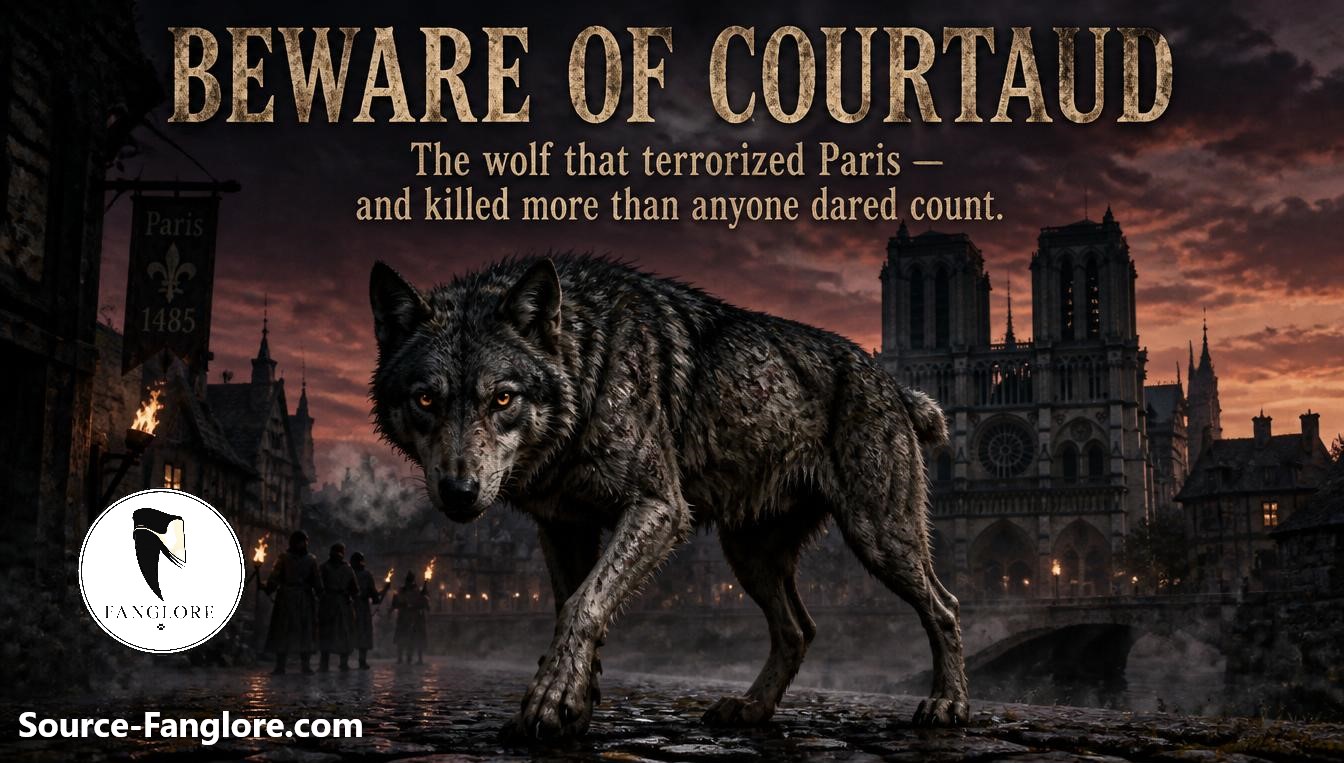
In the autumn of 1439, the people of Paris had a new name to fear. Not a soldier, not a plague — a wolf. They called him Courtaud, Old French for “short tail” or “stumpy tail,” and for months, he was blamed for some of the worst wolf attacks the city had ever seen. His story is one of the strangest and most vivid predator legends to survive from medieval Europe, half historical record, half campfire tale — and it still gets retold nearly six centuries later.
A City full of dreams turned into a place of horror by a single predator whose nature isn’t to kill humans was fascinating in itself, but scary as well.
A City Under Siege — By Wolves
To understand Courtaud, you have to understand the Paris he prowled. The early 15th century was brutal. France was deep in the Hundred Years’ War, and the fighting had emptied out villages, left fields untended, and piled up more corpses than anyone could properly bury. Wolves noticed.

An anonymous diarist known today as the “Bourgeois of Paris” recorded that as early as 1421, starving wolves were slipping into the outskirts of the city at night, digging up freshly buried bodies in nearby fields, and sometimes wandering right into Paris itself. That was unsettling enough. But by 1439, something had shifted — the wolves weren’t just scavenging the dead anymore. They were hunting the living, taking men, women, and children, and even picking off shepherds while leaving their flocks untouched, which struck contemporary observers as especially chilling.
History is filled with accounts of predators who, even if accidentally, get to taste human flesh, are bound to crave for more.
The numbers recorded are staggering for a single city. In the final week of September 1439 alone, the journal claims 14 people were killed and eaten by wolves in the countryside between Montmartre and the Porte St. Antoine. Between 1436 and 1440, wolves are estimated to have killed somewhere between 60 and 80 people around Paris.
Other chronicles of the era, including those of Jean Chartier, describe similar scenes: wolves swarming the areas around Paris in numbers that astonished eyewitnesses, some of them turning to eating people.
Still, it was quite unnatural for wolves to take the initiative to hunt for humans, that too in a city far from their usual hunting grounds. Circumstances could never be that dire, or were they….
The Beast With No Tail

Among all these wolves, one animal stood out. The Bourgeois of Paris journal describes it simply as a “terrible and horrible wolf” — one blamed for more deaths than every other wolf around the city combined. It was captured in the autumn of 1439, on the Eve of St. Martin, and it had a distinguishing feature: it was missing most of its tail. That single detail earned it the nickname that would outlive it by centuries — Courtaud.
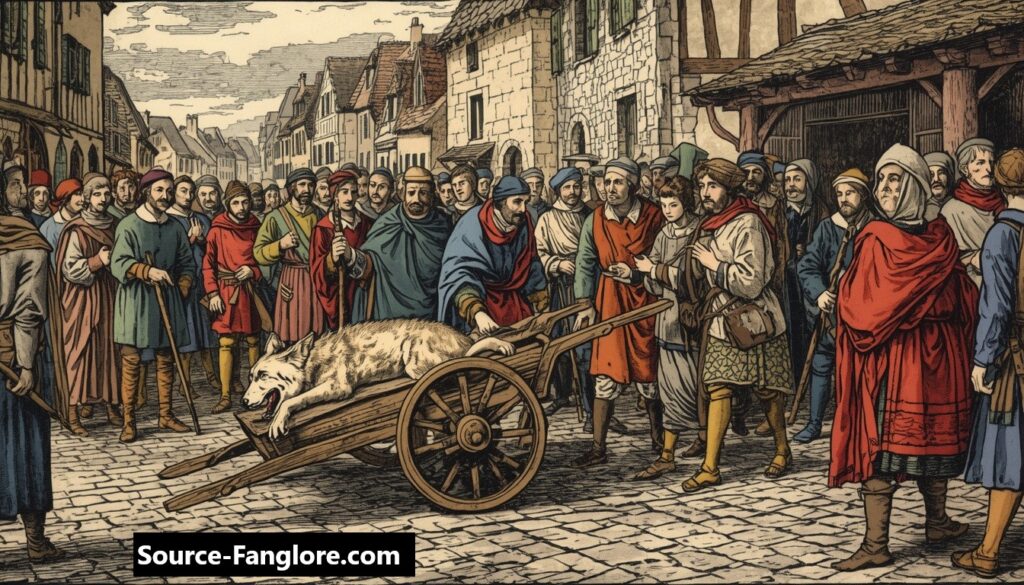
Word of Courtaud’s reputation spread fast enough that people heading out into the fields around Paris were warned outright to watch for him. When he was finally caught, the city didn’t just quietly dispose of him. His body was placed in a wheelbarrow, jaws propped open for all to see, and paraded through the streets of Paris. According to the journal, people dropped whatever they were doing to come see the carcass for themselves — the sight, the writer noted, felt worth more to onlookers than ten francs.
It’s always remarkable for humankind to be so excited about their triumphant win against beasts that once threatened them.
Why Did the Wolves Turn?
It’s a fair question and the answer you have been waiting for, as any reader would — wolves overwhelmingly avoid humans under normal conditions. So what changed?
Historians point to a grim convergence of factors. The Hundred Years’ War had left the countryside scarred: deserted villages, unburied dead, and a steady supply of wounded, elderly, and vulnerable people far from protection. On top of that, the mid-15th century brought a run of brutally cold winters and a severe famine between 1437 and 1439. One 18th-century historian, writing about the region, described how the devastation of constant conflict and the resulting famine were compounded by relentless rain that wiped out what resources remained — and that in the aftermath of that kind of disaster, packs of wolves would emerge from the forests and roam the countryside for months at a time.
If you take away a predator’s hunting grounds, it will come to your courtyard in search of one.
In short: war created the conditions, and famine and desperation did the rest. It wasn’t that wolves suddenly became a different animal — it’s that a starving, war-torn landscape pushed them toward behavior they’d otherwise never risk. Predators don’t kill for the joy of hunting but for survival.
The panic didn’t end with Courtaud, either. Decades later, when Louis XI took the French throne, he ordered large-scale wolf hunts across the region. In just six months in 1461, 227 wolves were officially killed in the viscounty of Paris alone — a staggering number that hints at just how large the wolf population around the capital had grown.
From Historical Record to Legend

Courtaud might have stayed a footnote in a medieval journal if not for later writers who picked up his story and ran with it. Naturalist and author Ernest Thompson Seton gave Courtaud a much fuller, dramatized retelling in his 1937 book Mainly About Wolves — though Seton himself admitted he’d embellished and expanded the tale freely, even while insisting the broad strokes were historically accurate. That embellished version, combined with the original journal account, later formed the basis for Daniel P. Mannix’s The Wolves of Paris, which cemented Courtaud’s place in wolf folklore for a modern audience. His story has since inspired other novels bearing that same title.
Survival instincts were all it took for a species to hunt for a new prey, and the chaos it wrought was insane.
The Takeaway
Courtaud isn’t really a story about a monster. It’s a story about what happens when war, famine, and desperation collide — for both people and predators. The wolf that terrorized Paris in 1439 wasn’t some supernatural anomaly; he was very likely just the most successful survivor of a population pushed to its absolute limit by human conflict. That’s arguably scarier, and more interesting, than any myth could be.
Six hundred years later, Courtaud still stalks the pages of wolf history books — proof that some predator stories never really let go of us.
It serves as proof that when wars, famines, and existential crisis happens, every living creature adapts to whatever options they have for survival, even if it makes them a monster in someone’s books.
Check out our post on the Legendary Lion of Savuti –https://fanglore.com/ntwadumela-the-legendary-lion-king-of-savuti-who-fought-fearlessly-until-the-end/
Leave a Reply